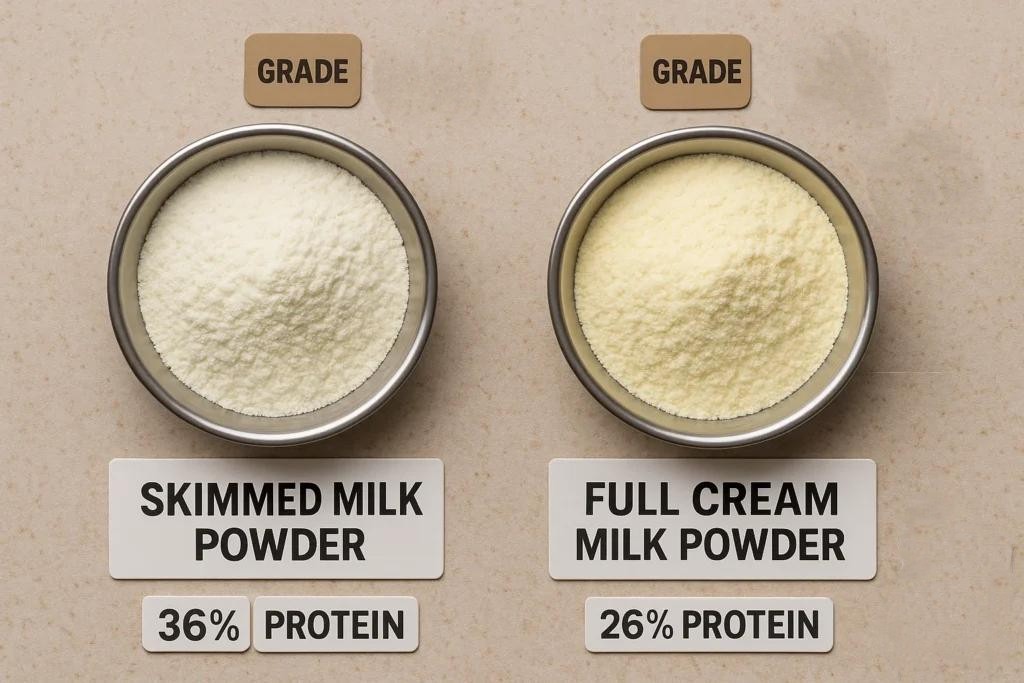
SMP vs Full Cream Milk Powder: What Is the Difference and Which One Should You Choose?
Milk powder is an important dairy ingredient used across the food and beverage industry. From dairy beverages and yogurt to ice cream, bakery products and confectionery, manufacturers use different types of milk powder depending on their formulation and production requirements.
Two of the most commonly used options are Skimmed Milk Powder (SMP) and Full Cream Milk Powder (FCMP), also commonly referred to as Whole Milk Powder (WMP).
Although both products originate from milk, they have important differences in milk-fat content, nutritional composition, flavour, formulation properties, applications and cost considerations.
Understanding these differences is essential for food manufacturers, dairy processors, importers and procurement teams.
What Is SMP Milk Powder?
SMP stands for Skimmed Milk Powder.
SMP is produced by removing most of the milk fat from milk and then removing water through concentration and drying.
According to the Codex Standard for Milk Powders and Cream Powder, Skimmed Milk Powder contains a maximum of 1.5% milk fat, with a maximum water content of 5% and a minimum milk-protein requirement of 34% in milk solids-not-fat.
Because of its low fat content, SMP is particularly useful when manufacturers need milk solids and protein without adding a high level of milk fat.
What Is Full Cream Milk Powder?
Full Cream Milk Powder, commonly called Whole Milk Powder (WMP), is produced by removing water from whole milk while retaining a substantially higher proportion of the milk's natural fat.
Under the Codex standard, Whole Milk Powder contains at least 26% and less than 42% milk fat, with a maximum water content of 5% and a minimum milk-protein requirement of 34% in milk solids-not-fat.
The higher fat content gives Full Cream Milk Powder a richer dairy flavour and makes it suitable for applications where creaminess, body and milk-fat are important.
SMP vs Full Cream Milk Powder: Key Differences
The most important difference between SMP and Full Cream Milk Powder is their milk-fat content.
FeatureSMPFull Cream / Whole Milk PowderFull NameSkimmed Milk PowderFull Cream / Whole Milk PowderMilk FatMaximum 1.5%26% to less than 42%ProteinMinimum 34% in milk solids-not-fatMinimum 34% in milk solids-not-fatWaterMaximum 5%Maximum 5%FlavourMild, less creamyRicher, creamierFat ContributionVery lowHighTypical UsesRecombined milk, yogurt, bakery, ice creamDairy beverages, ice cream, chocolate, bakeryFormulation FocusMilk solids & protein with low fatMilk solids, protein & milk fat
The specifications above are based on the Codex standard; individual commercial products can have more specific specifications depending on grade and application.
1. Difference in Milk Fat
This is the biggest difference between the two products.
SMP
SMP contains no more than 1.5% milk fat under the Codex definition.
This makes it suitable for formulations where manufacturers want to increase milk solids and protein while keeping fat relatively low.
Full Cream Milk Powder
Whole Milk Powder contains 26% to less than 42% milk fat under the Codex standard.
The higher fat content contributes to a richer flavour, creamier mouthfeel and different functional characteristics.
2. Difference in Taste and Mouthfeel
The difference in fat content also affects sensory characteristics.
SMP generally provides a lighter dairy profile because of its low milk-fat level.
Full Cream Milk Powder provides a richer and creamier dairy character because of its higher fat content.
For products where a rich milk taste is a key selling point, Full Cream Milk Powder may be preferable.
For formulations where manufacturers control the fat level separately, SMP may provide greater flexibility.
3. Difference in Nutritional Composition
Both products provide important milk-derived nutrients, including protein and milk solids.
However, the overall nutritional profile differs because of their very different fat levels.
SMP provides milk protein and milk solids with relatively little milk fat.
Full Cream Milk Powder provides milk protein and milk solids together with substantially more milk fat.
Therefore, the choice depends on the nutritional and formulation requirements of the finished product.
4. SMP vs Full Cream Powder for Recombined Milk
SMP is widely used in the production of reconstituted and recombined milk products.
Reconstituted milk can be produced by adding water to SMP, WMP or a combination of the two to achieve the desired composition. Recombined milk can involve SMP together with separately added milk fat to reach the target fat content.
This gives manufacturers flexibility to control the final fat level.
For example:
SMP + Water + Milk Fat ? Recombined Milk
This approach can be useful for manufacturers who want to control milk solids and fat independently.
5. SMP vs Full Cream Powder for Yogurt
Both SMP and Full Cream Milk Powder can be used in yogurt manufacturing.
SMP can help increase milk solids and protein while keeping additional fat low.
Full Cream Milk Powder can contribute both milk solids and additional milk fat, which can be useful in richer yogurt formulations.
The correct choice depends on the target:
Low-fat formulation ? SMP may be more suitable
Richer, creamier formulation ? Full Cream Milk Powder may be preferred
6. SMP vs Full Cream Powder for Ice Cream
Ice cream manufacturers need to carefully balance milk fat, milk solids-not-fat, sugar and other ingredients.
SMP can provide milk solids and protein without significantly increasing milk fat.
Full Cream Milk Powder contributes both milk solids and a substantial amount of milk fat.
Therefore:
SMP ? greater flexibility when controlling fat separately
Full Cream Milk Powder ? additional dairy fat and richer milk character
The final decision should be based on the required recipe, target cost and desired sensory properties.
7. Applications in Bakery and Confectionery
Both types of milk powder can be used in bakery and confectionery applications.
SMP can be useful where manufacturers want to add milk solids and protein without significantly increasing fat.
Full Cream Milk Powder can be selected where a richer dairy flavour and additional milk fat are desirable.
Applications may include:
- Biscuits
- Cookies
- Cakes
- Bread
- Chocolate
- Confectionery
- Bakery mixes
- Dessert products
8. Which One Is More Cost-Effective?
There is no universal answer to whether SMP or Full Cream Milk Powder is cheaper.
The correct comparison should consider the complete formulation cost, rather than simply comparing the price per kilogram.
For example, a manufacturer using SMP may need to add another source of milk fat to achieve a specific formulation.
On the other hand, Full Cream Milk Powder already contains substantial milk fat.
Therefore, manufacturers should calculate the cost of achieving the required nutritional and functional composition.
A useful approach is:
Total Formulation Cost = Milk Powder Cost + Additional Dairy Ingredients + Processing Cost + Logistics + Storage + Wastage
This provides a more meaningful comparison than looking only at the purchase price.
9. Which One Is Better for Bangladesh?
For manufacturers in Bangladesh, the choice between SMP and Full Cream Milk Powder should depend primarily on the product formulation and manufacturing objective.
SMP can be particularly attractive for manufacturers producing:
- Recombined milk
- Low-fat dairy beverages
- Yogurt
- Ice cream
- Bakery products
- Biscuits
- Food formulations requiring milk protein and solids
Full Cream Milk Powder can be more appropriate for:
- Full-fat dairy beverages
- Premium milk products
- Rich ice cream
- Chocolate and confectionery
- Bakery products requiring additional dairy fat
- Products where a rich milk flavour is desired
The Bangladesh market also requires manufacturers to consider landed cost, import duties, freight, exchange rates, storage and supplier reliability when selecting dairy ingredients.
10. How to Choose the Right Milk Powder
Before purchasing SMP or Full Cream Milk Powder, manufacturers should consider:
1. Product Formulation
What are the required fat, protein and milk-solids levels?
2. Application
Will the powder be used in milk, yogurt, ice cream, bakery, biscuits or confectionery?
3. Solubility
Is instant or regular powder required?
4. Heat Classification
For SMP, the heat treatment classification can affect functional properties and solubility. Tetra Pak describes low-, medium- and high-heat classifications for skim milk powder based on the heat treatment applied during production.
5. Quality Parameters
Check:
- Protein
- Fat
- Moisture
- Solubility
- Heat classification
- Microbiological specifications
- Sensory characteristics
- Packaging
- Shelf life
6. Certificate of Analysis
A reliable supplier should provide a Certificate of Analysis (COA) for the product/batch, showing that it meets the agreed specification.
SMP or Full Cream Milk Powder: Which One Should You Choose?
There is no single winner.
The better product depends on what you want to achieve.
Choose SMP when:
You need:
- Low milk-fat
- Milk protein
- Milk solids
- Formulation flexibility
- Controlled fat addition
- An ingredient for recombined milk or other low-fat formulations
Choose Full Cream Milk Powder when:
You need:
- Higher milk fat
- Richer dairy flavour
- Creamier mouthfeel
- A convenient source of both milk solids and milk fat
- Full-fat dairy formulations
Final Verdict
SMP and Full Cream Milk Powder are both valuable dairy ingredients, but they serve different formulation purposes.
SMP is primarily a low-fat source of milk solids and protein, while Full Cream Milk Powder provides milk solids together with a significantly higher level of milk fat.
For Bangladesh's growing food and dairy-processing industry, understanding this difference can help manufacturers make better decisions regarding product quality, formulation, production efficiency and total cost.
The best choice should always be based on the finished product specification, technical requirements and total formulation economics, rather than price alone.
If you are sourcing SMP or Full Cream Milk Powder for industrial production, always compare the supplier's technical specification, COA, application suitability, consistency and total landed cost before making a purchasing decision.
Frequently Asked Questions
Is SMP the same as Full Cream Milk Powder?
No. SMP has a maximum milk-fat content of 1.5% under the Codex standard, while Whole Milk Powder contains 26% to less than 42% milk fat.
Which has more fat, SMP or Full Cream Milk Powder?
Full Cream/Whole Milk Powder has substantially more milk fat.
Which is better for recombined milk?
SMP is commonly used as the non-fat milk-solids component in recombined milk, with milk fat added separately when required.
Can SMP be used for ice cream?
Yes. SMP can provide milk solids and protein while allowing manufacturers to control the fat content separately.
Can Full Cream Milk Powder be used in bakery products?
Yes. Whole Milk Powder is used in bakery and confectionery applications and can provide milk solids, protein and milk fat.
Is Full Cream Milk Powder always more expensive than SMP?
Not necessarily. Pricing varies by market, origin, specification, supply conditions and other factors. The correct comparison should be based on the total cost of achieving the desired formulation.

Innovative Agro Aid
Official Editorial Team